
Reactive vs Preventive Maintenance: The Real Cost Gap
Commercial building owners typically rely on a combination of reactive and preventive maintenance to protect building assets. In this guide, we explore preventive maintenance vs. reactive maintenance, including their costs and risks.
What reactive maintenance actually means in practice
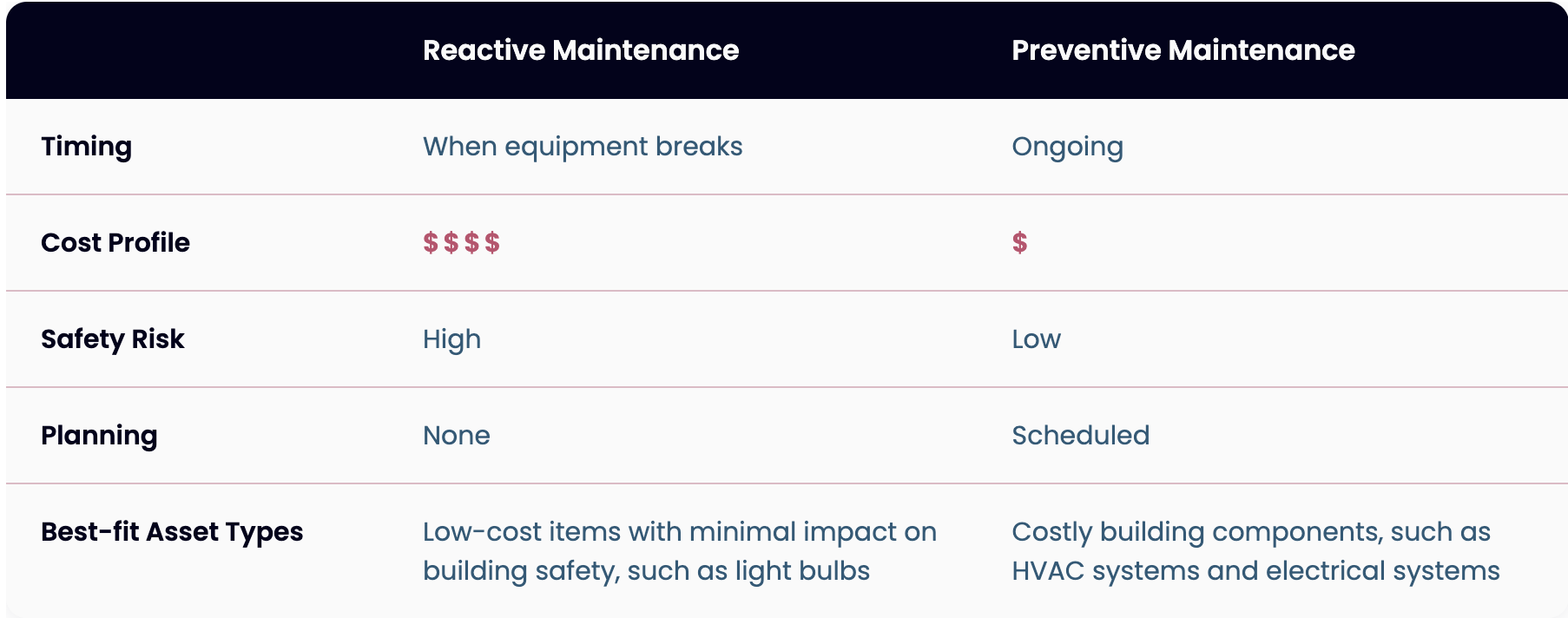
In a reactive maintenance strategy, property managers fix equipment when it breaks. Instead of engaging in routine maintenance or monitoring, teams wait until there's a total failure of the system.
A reactive approach makes sense for inexpensive, non-critical, and disposable assets that don't significantly impact building operations or occupancy. However, it becomes a liability when applied to costly systems that affect tenant safety or comfort, such as elevators or HVAC systems.
Let's take an example. Assume that you take a reactive approach to maintaining a commercial building's plumbing system. One day, a pipe bursts, breaking through the wall and flooding the second floor. The cleanup costs thousands of dollars in emergency labor, and you're also on the hook for plumbing repairs. Your building tenants aren't happy either, since they've lost expensive belongings and access to their space.
Such a problem might be avoided with preventive upkeep. Regular monitoring and routine maintenance could identify a leaking or loose pipe before it becomes a major repair.
How preventative maintenance changes the cost equation
Preventive maintenance aims to catch minor issues before they transform into something bigger. It does this by inspecting equipment regularly, before failures occur. Types of preventive maintenance fall into five categories:
Time-based: Follows a set schedule to assess equipment performance.
Usage-based: Performed based on a system's usage or run-hours.
Condition-based: Completed when equipment demonstrates wear or deterioration.
Predictive: Uses data to identify when a system may fail.
Failure-finding: Relies on inspections to test whether equipment is operating properly.
Taking a preventative approach to maintenance saves money on emergency labor costs and parts. In fact, a single reactive repair can cost up to three to four times more than planned maintenance. Property owners who follow a preventive strategy may also reduce their operating expenses by 12–18%.
That's not to say that pre-emptive maintenance is cheap. Over-maintaining equipment can escalate operational expenses significantly. For optimal results, it's best to follow a schedule that matches the actual condition of building equipment.
Here's a look at how reactive maintenance vs preventive maintenance strategies compare in a commercial building setting.
Where most buildings actually land (and why)
In reality, most commercial buildings follow a mixed approach of reactive vs preventive maintenance. A common benchmark is the 80/20 split, where 80% of maintenance consists of planned, preventive work, while 20% is reactive. The combination of strategies helps owners stay within their operating budget.
A Computerized Maintenance Management System (CMMS) is frequently used by property managers to plan, schedule, and track maintenance activities. CMMS platforms organize tasks within a single database, allowing teams to view upcoming and completed maintenance for critical business assets.
Predictive maintenance: where real-time data takes this further
With a predictive maintenance system, teams can modernize building infrastructure with sensor technology. These sensors capture data and convert it into useful insights that highlight equipment inefficiencies and faults. Data is transferred to a centralized platform, where teams can view equipment operational trends and alerts.
For example, a preventative system using real-time data can improve HVAC operations. Sensors detect vibrations, temperature trends, and energy draw anomalies. If sensor data detects a decline in HVAC performance and reliability, maintenance teams can investigate and fix the issue before a costly breakdown occurs.
With a predictive maintenance solution, facility teams can interpret data to make condition-based maintenance decisions, rather than timing-based ones.
Shifting from reactive to proactive operations over time
For most building owners, moving to a more preventive and predictive method of maintenance won't happen overnight. It requires pre-planning and research.
You can start by performing an assessment of your building's most critical assets. Include equipment that's costly to repair and carries a significant failure risk at the top of your list for optimization. Assets such as HVAC systems, electrical transformers, and plumbing and water systems are suitable for continuous monitoring. Adding them to a real-time building energy management system could yield strong financial benefits.
Lesser components, such as non-essential appliances, fixtures, and lights, may not need preventive maintenance. It's often cheaper to repair or replace them when they break, rather than using scheduled maintenance or sensors to track their performance.
Mature facility teams take a progressive approach to maintenance. They consider costs, risks, and budget when deciding which building components are best suited for preventive or predictive maintenance.
Attune is a market-leading building monitoring and intelligence platform designed for commercial properties. Our solutions help property managers monitor critical assets, including HVAC systems, pumps, and more. To learn more about how Attune can help you protect your building, schedule a demo today.
Frequently Asked Questions
What is the difference between reactive and preventive maintenance?
In a reactive maintenance strategy, teams fix equipment when it breaks. They don't use scheduled inspections to check an item's functionality or performance. Preventive maintenance follows a time, usage, or wear-based schedule to assess equipment condition. It may detect problems before a major breakdown occurs.
What are the 4 types of maintenance?
The four types of maintenance include preventive, reactive, reliability-centered, and predictive. Preventive maintenance follows a schedule to inspect equipment before failure, while reactive maintenance waits until something breaks to implement a fix. Reliability-centered maintenance examines equipment's potential failures and creates a unique inspection plan for it. Predictive maintenance uses sensors to detect problems that may lead to a failure.
What is an example of reactive maintenance in a commercial building?
Waiting for an HVAC system to stop working is an example of reactive maintenance in a commercial building. In this case, property managers must rely on costly emergency labor and parts to repair the machine. Downtime from reactive maintenance can frustrate occupants and result in building discomfort.
Is reactive maintenance ever the right choice?
Reactive maintenance is a solid approach for inexpensive equipment that's easy to replace. Items such as lightbulbs and toilet flappers are well-suited for reactive maintenance.